
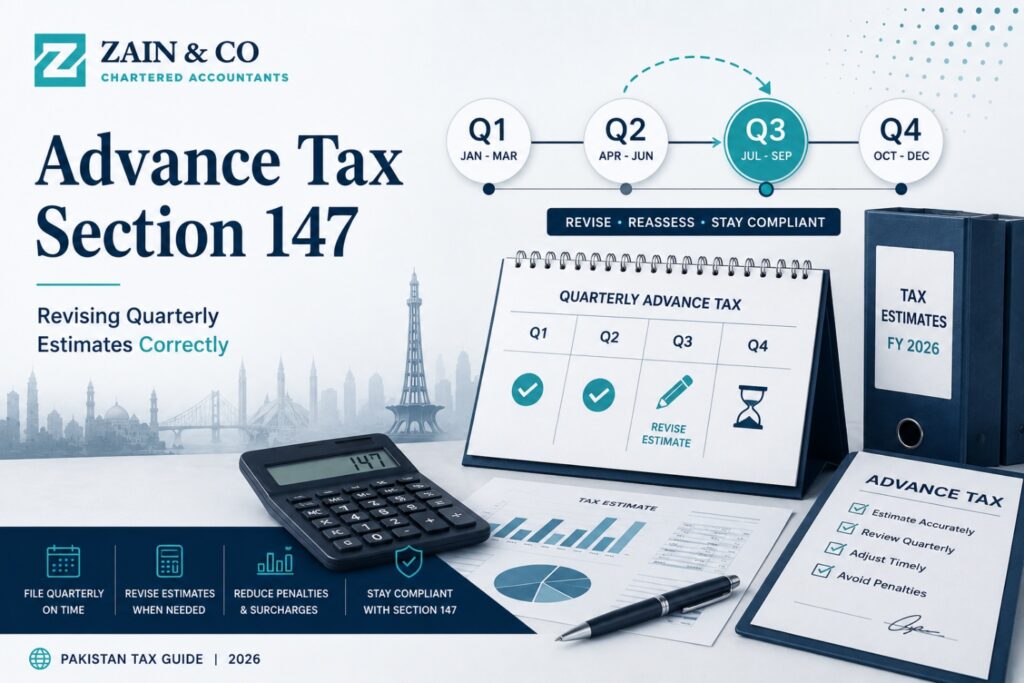
Advance Tax Section 147 Pakistan 2026: How to Revise a Quarterly Estimate That’s Gone Wrong
Most articles about Section 147 just give you the formula: guess your tax for the year, split it into four, pay one part each quarter, and adjust for whatever’s already been withheld. That part is true, but it’s only half the story. Your first guess isn’t locked in for the whole year, and most businesses never find out they could change it until they’ve already paid too much or too little.
Who this actually applies to
If your net tax bill for last year was more than Rs 1 million, you have to pay this year’s expected tax in four parts through the year, instead of all at once when you file. Companies and AOPs (groups running a business together) fall under this rule once their taxable income crosses the line set out in the law, separate from the general Rs 1 million rule. This isn’t something you can choose to skip once it applies to you, and FBR doesn’t remind you about it. You’re expected to work it out yourself.
A real change for exporters under Finance Act 2026
If you export goods, or you’re an indirect exporter, there’s a real change here that the general rules above don’t cover. Finance Act 2026 got rid of the extra 1% advance tax that used to apply under Section 147(6C), taken from exporters and related people at the moment foreign money or export payments came in. That extra 1% existed to help exporters with their cash flow (that was the reason it got added in the first place, under Finance Act 2024), and getting rid of it is a real, dated win if it applied to you. It’s separate from the general quarterly system above. It was its own specific charge, and now it’s gone.
Worth knowing alongside this: Finance Act 2026 also raised a different rate for exporters, under Section 154, from 1% to 1.25%, on export payments treated as minimum tax. It raised the same rate for indirect exporters too. So removing the extra 1% under 147(6C) and raising the 154 rate happened in the same law, at the same time. An exporter’s real, overall position depends on both changes together, not just the good news on its own. Worth actually running your numbers rather than assuming it’s all upside.
The part almost nobody explains: you can change your estimate
Here’s what most guides skip completely. If, partway through the year, you can see your real tax bill is going to land somewhere different from your first guess, you’re not stuck paying based on a number you now know is wrong.
⦁ If your real bill looks lower than your first guess, you can file a lower, revised estimate. But you have to file it before the fourth payment is due. Miss that window, and you’re stuck paying the fourth payment based on the old, higher number, whatever your real numbers now show.
⦁ If your real bill looks higher than your first guess, you’re required to file a higher, revised estimate before the second payment is due, and pay accordingly. This one matters more than it sounds, because paying too little based on a guess you already knew was wrong is exactly what triggers an extra charge later.
This matters most for any business whose income isn’t steady all year: seasonal sales, a big contract landing mid-year, an export order that shifts between quarters. A business that just divides last year’s number by four and pays the same amount every time, without checking again, ends up either handing over cash too early, or quietly building up a charge it won’t notice until the year is over.
What happens if you get it wrong
If you don’t pay the right advance tax on time, you get a default surcharge under Section 205 on whatever’s unpaid, generally 12% a year or KIBOR plus 3%, whichever is higher, counting from the due date until you actually pay. The Appellate Tribunal (a tax court) has been firm on this recently, saying the rule to deposit advance tax is not optional, and a shortfall does trigger the charge under Section 205’s specific advance tax rules.
There’s a more technical point worth knowing, even though it doesn’t change what you should actually do. Whether this charge needs proof that you meant to underpay, rather than just applying automatically to any shortfall, is a real, ongoing question in Pakistani tax law right now. One reported case, Tianshe International Pakistan Co. (2018 PTD 900), said charging this surcharge without proving intent was wrong. Other tax authorities disagree, partly because of an Indian Supreme Court ruling that said this kind of charge isn’t a punishment, so intent shouldn’t matter. There’s also an argument about wording: the Sales Tax Act’s version of this rule specifically covers people who default “on purpose or not,” while Section 205 of the Income Tax Ordinance doesn’t say that, and some argue that gap should matter. Some current cases also involve situations where a court itself was controlling when someone had to pay, and the argument there is that nothing counts as “late” during a period the court was controlling. None of this is settled yet. In practice, it means a surcharge notice isn’t automatically the final word, especially if the shortfall came from a reasonable guess rather than deliberately avoiding payment, and it’s worth a second look instead of just paying it.
The basic math, for reference
Each quarterly payment is usually one-quarter of your expected tax for the year, minus whatever tax was already paid or withheld that quarter (some types of withholding don’t count toward this). The due dates fall roughly three months apart through the year. The exact dates, and whether companies and non-companies have different dates, are worth checking against the current FBR calendar for the specific tax year, since these details shift.
Where businesses get this wrong
⦁ Never going back to check the original guess. The rule isn’t “take last year’s number, divide by four, forever.” It’s meant to track your real, current picture, and the law gives you a specific way to fix it.
⦁ Missing the window to lower your estimate. If you wait past the fourth payment’s due date to notice your guess was too high, the chance to fix it for that year is already gone.
⦁ Treating a surcharge notice as automatically final. Given the real, ongoing legal debate around intent and court-controlled payments, a notice based purely on a shortfall, with no sign of anyone trying to avoid paying, is worth a second look rather than paying it without question.
⦁ Assuming this only applies to companies. AOPs and individuals with business income above the threshold are covered too, not just registered companies.
⦁ Assuming the exporter changes cancel each other out without doing the math. Exporters got real relief on one line and a rate increase on another, in the same law. Assuming it’s a wash, or assuming it’s pure benefit, without actually calculating both, is how a business gets its own cash flow wrong for the year.
Need Tax Advice?
Whether you’re filing an annual tax return, reviewing your company’s tax position, responding to an FBR notice, or planning for the latest Finance Act changes, our team at Zain & Co Chartered Accountants is here to help.
We work with individuals, SMEs, and corporate clients across Pakistan, providing practical tax advice, compliance support, and strategic corporate advisory services.
Get in touch with us to discuss your requirements.
FAQ
Do I have to pay advance tax every single year once it applies to me?
Yes. Once your net tax bill from last year passed the threshold, the quarterly rule applies again this year, based on your new estimate.
Can I change my estimate partway through the year?
Yes. A lower, revised estimate has to be filed before the fourth payment is due. A higher, revised estimate has to be filed before the second payment is due.
What happens if I pay too little because my original guess was wrong?
A default surcharge usually applies on the shortfall, from the due date until you pay, under Section 205, at 12% a year or KIBOR plus 3%, whichever is higher. Whether this needs proof that you meant to underpay, instead of applying automatically, is a real and unsettled question in current Pakistani tax cases, worth raising if your shortfall came from a reasonable guess.
Does this apply to AOPs, or only companies?
Both, plus individuals with business income, once the threshold is crossed.
I’m an exporter. Did anything change for me under Finance Act 2026?
Yes, two things. The extra 1% advance tax under Section 147(6C) on exporters and indirect exporters, taken when export money came in, has been removed. At the same time, the Section 154 rate on export payments, treated as minimum tax, went up from 1% to 1.25%. Look at both together to see your real position.
Current as of mid-2026, including the removal of the extra 1% advance tax under Section 147(6C) and the increase in the Section 154 export rate to 1.25%, both from Finance Act 2026. Please check exact due dates and how specific types of withholding get offset against the FBR calendar for the tax year in question, before using this for a real filing decision.
