
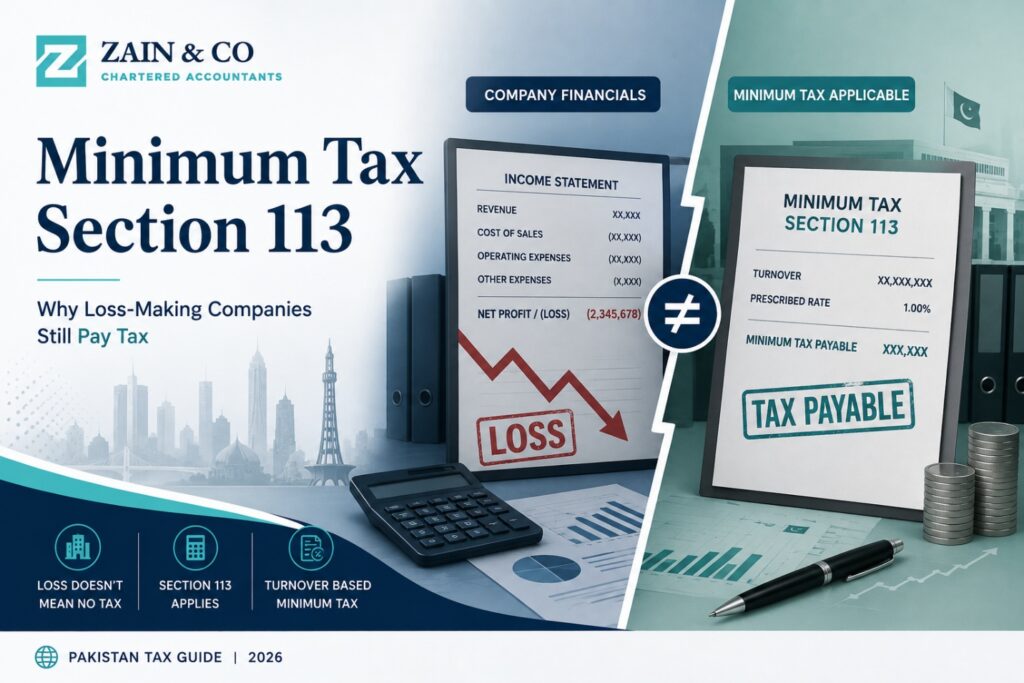
Minimum Tax Section 113 Pakistan 2026: Why a Loss-Making Company Can Still Owe Tax
A year where your company loses money feels like it should mean no tax bill. Under Section 113 of the Income Tax Ordinance, it usually doesn’t work that way.
Section 113 sets a minimum tax based on your turnover, meaning all the money that came into your business. It kicks in whenever your normal tax bill, the one based on profit, comes out lower than this minimum, including when it comes out at zero because you had a loss. In that case, the tax isn’t based on profit at all. It’s based on the total money coming in, no matter what happened after that.
Which one you actually pay
| What’s happening | What you pay |
| Your normal tax (29% of profit, or your rate) is more than the minimum tax on turnover | Your normal tax |
| Your normal tax is less than the minimum tax on turnover | The minimum tax on turnover instead |
| Your company had a loss, so normal tax comes out to zero | The full minimum tax on turnover |
The rate isn’t the same for every business. Most companies pay 1.25%. But some industries get a lower rate, listed separately under Clause 24D of the Second Schedule, and this list keeps changing. Finance Act 2026 doubled the lower rate for distributors, dealers, sub-dealers, wholesalers, and retailers of certain goods, from 0.25% up to a flat 0.5%, starting 1 July 2026. To get this lower rate, the business has to appear on both the sales tax and income tax Active Taxpayer Lists. The list of goods also changed. The old idea of “fast-moving consumer goods” is gone, replaced with a named list: medicine, fertilizer, cigarettes, sugar, phones made in Pakistan (imported phones don’t count), electronics, cement, steel, cooking oil, and various packaged food, drinks, and dairy items. This is exactly the kind of thing where any number or list you read is worth double-checking against the current Second Schedule for your own industry, because the exact goods list already changed once this year, and different write-ups describe the edges of it slightly differently.
The mix-up almost every guide gets wrong
This is where the real confusion is, and it’s worth getting exactly right, because getting it wrong costs money either way.
Your loss doesn’t cancel out Section 113. If your business lost money this year, that loss doesn’t lower or cancel the minimum tax on turnover. The two numbers don’t touch each other. You still owe the minimum tax on your total money in, full stop, no matter how big the loss was.
But extra minimum tax you paid can usually be carried forward. If you end up paying the minimum tax because it was higher than your normal tax would have been, the gap between the two can usually be carried forward for a set number of years and used against your normal tax bill once you’re properly profitable again.
These are two separate things, and a lot of guides online mix them together. Some flatly say losses “can’t be carried forward” under Section 113, which makes it sound like there’s no future relief at all. That’s not quite right. The loss itself gets no relief against Section 113 today. But the extra tax you were forced to pay because of it can get relief later. If your accountant only tells you one of these, ask which one they mean.
What this actually looks like
Say a company makes Rs 500 million in sales for the year, but ends up with a loss, so its normal tax bill is zero. At a 1.25% rate, that’s Rs 6.25 million owed anyway, loss or no loss. If next year the company actually turns a profit, and its normal tax bill would otherwise be, say, Rs 8 million, it might be able to use some of that extra minimum tax from the loss year to lower this year’s bill, depending on the rules and time limits in place then. The business owner who assumed “no profit means no tax” during the loss year is the one who gets surprised by the first bill, not by how the carry-forward works later.
Where companies actually get this wrong
⦁ Thinking a real loss means a real zero tax bill. It means a minimum tax bill instead, based on your total sales, and you can’t argue it down with expense receipts.
⦁ Using a rate they read somewhere without checking if it’s changed. The lower rate for distributors and wholesalers going from 0.25% to a flat 0.5% under Finance Act 2026, plus the new goods list, is exactly the kind of change that makes a number you read six months ago wrong today.
⦁ Assuming the extra minimum tax they paid just disappears. It usually doesn’t, but claiming it back later needs the paperwork from the year you paid it, which is easy to lose track of if nobody flagged it at the time.
⦁ Mixing up minimum tax with super tax. Minimum tax under Section 113 is based on total sales. Super tax under Section 4C is a completely different tax, based on profit above a much higher line (Rs 500 million for most companies from Tax Year 2026, or Rs 150 million for banks, oil and gas companies, and fertilizer sellers). A company might owe one, both, or neither in the same year, since they’re worked out completely differently.
Need Tax Advice?
Whether you’re filing an annual tax return, reviewing your company’s tax position, responding to an FBR notice, or planning for the latest Finance Act changes, our team at Zain & Co Chartered Accountants is here to help.
We work with individuals, SMEs, and corporate clients across Pakistan, providing practical tax advice, compliance support, and strategic corporate advisory services.
Get in touch with us to discuss your requirements.
FAQ
If my company had a loss, do I still owe tax?
Often yes, under Section 113, based on your total sales, not your zero or negative profit.
Does my business loss lower the minimum tax I owe?
No. The loss and the minimum tax are worked out separately, and one doesn’t reduce the other in the year the loss happens.
Can I get anything back for the minimum tax I paid during a loss year?
Usually yes, as the extra amount between what you paid and what your normal tax would have been. That extra amount can usually be carried forward and used against your normal tax bill in a future profitable year, within the allowed time limit.
What’s the actual rate?
The normal rate is 1.25% of your total sales, though some industries get a lower rate that changes over time. Distributors, dealers, sub-dealers, wholesalers, and retailers of a set list of goods, including medicine, fertilizer, cigarettes, sugar, phones made in Pakistan, cement, steel, cooking oil, and various packaged food and drink items, moved from a 0.25% lower rate to a flat 0.5% under Finance Act 2026, starting 1 July 2026. Check your industry’s current rate and whether you qualify, under Clause 24D of the Second Schedule, rather than trusting an older number.
Current as of mid-2026, including the Finance Act 2026 rate change for distributors and wholesalers, starting 1 July 2026. Minimum tax rates by industry are listed in the Second Schedule to the Income Tax Ordinance 2001, and they change from time to time. Please check the exact rate, the exact goods covered, and the carry-forward time limit for your own business before using any number here to file a return.
